

As AI systems move from experimentation into real production workflows, organizations need a secure, governed way to connect models to company systems and data. That’s where MCP servers are quickly becoming essential.
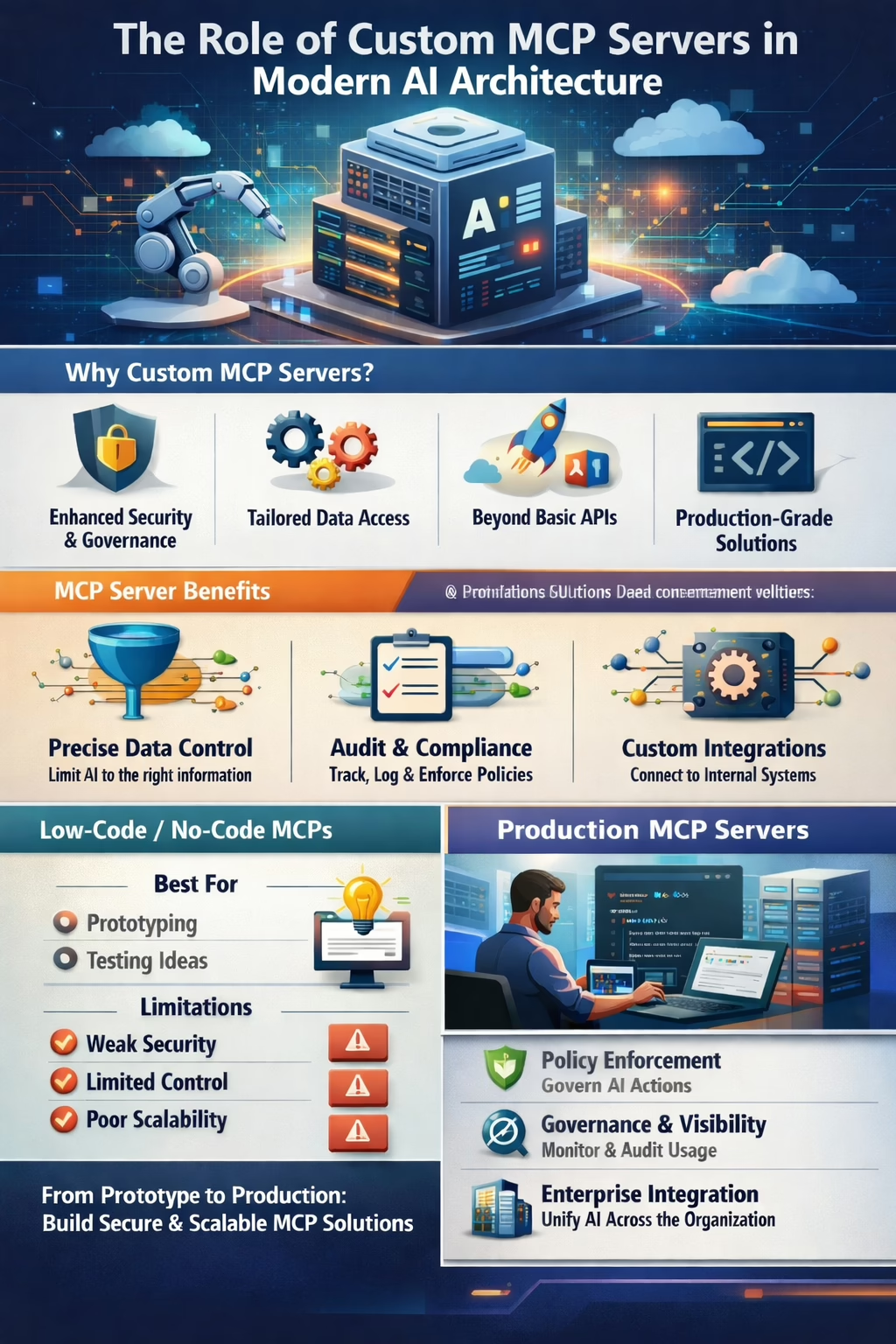
Summary
-
1MCP servers provide connectivity and control for how AI systems use and interact with your company data.
-
2A custom-built MCP server improves security, governance, and reliability by enforcing your policies at the point of AI access.
-
3Low-code / no-code MCPs are best for prototyping—they can fall short for scalability, security, and mission-critical workloads.
-
4Serious AI adoption requires treating MCP infrastructure as software, not just something to configure.
What MCP Servers Do (and Why They Matter)
MCP servers provide tools that allow modern AI systems to connect to resources beyond what they’ve been provided in a single model context.
That might be your accounting system, your CRM, or a custom internal platform.
Why “just use existing APIs” often breaks down
-
APIs often return too much. They’re designed for applications, not for context-limited AI tool use, so they may return bulk data
instead of only what the AI needs for the current task. -
APIs don’t always provide the right control model. Some are all-or-nothing, others are constrained by the connected user,
and many lack granular guardrails. - APIs can limit visibility. It’s often hard to see exactly what was requested, what was returned, and what the AI did next.
With an MCP server, you can provide exactly what’s needed for the specific interaction—no extra content to confuse the AI,
and no unnecessary functionality that expands your risk surface. You can also track, audit, and adjust tool behavior based on
predefined rules the AI can’t override.
MCP and Security Posture
You’ve likely seen the headlines: “We told AI not to delete the database… but it did it anyway.”
MCP can be the secure entrance into your data and network—but not all MCP servers are created equal.
- Over-broad permissions
- Hardcoded credentials
- Lack of auditability
- Limited isolation between tools or data sources
Custom MCP servers let you apply your security principles to AI interactions—identity, access boundaries,
auditing, and policy enforcement—without relying on generic assumptions.
Low-Code / No-Code MCPs: When They’re Useful and Where They Fall Short
When to use low-code / no-code MCPs
- Experimentation and internal testing
- Prototyping workflows
- Validating a use case before engineering investment
Where they fall short
- Coarse-grained permissions
- Limited support for custom authentication flows
- Limited visibility into parts of the process
- Weak audit and compliance capability
- Hard to version, test, and govern
Low-code MCPs optimize for speed and reduced engineering effort—not for control.
That tradeoff is fine during exploration, but it becomes a liability in production.
Production MCP Servers Require Real Code
Why code matters in production
- Security policies are logic, not just GUI configuration
- Real error handling and retries that surface actionable failures
- Domain-specific validation and guardrails (what “safe” means depends on your business)
- Testability (unit, integration, security testing)
- CI/CD, version control, and rollback support like the rest of your platform
Don’t cut corners: if MCP is part of your production AI stack, it should meet the same standards as the rest of your software platform.
Choosing the Right MCP Strategy for Your Organization
Use these questions to pressure-test whether you need a custom MCP server:
If the answer to any of the above is yes, building a custom MCP server is typically the better long-term choice.
Looking Ahead: MCP as a Long-Term Control Plane for AI
MCP servers are evolving into a three-part bastion for modern AI:
1) Policy enforcement
Control what AI can access and what actions it can perform—at the boundary where it matters.
2) Governance and visibility
Centralize audit trails, usage patterns, and operational accountability across AI tools.
3) Shared enterprise structure
Create a consistent integration pattern for teams building AI capabilities across the organization.
Organizations that invest early in custom MCP servers can achieve a stronger security posture, faster iteration with AI,
and lower long-term risk.
Building AI responsibly requires more than prompts and plugins.
If you’re moving beyond experimentation and into real-world AI systems, your MCP strategy matters.
Let’s talk about designing an MCP architecture that scales securely—from prototype to production.
